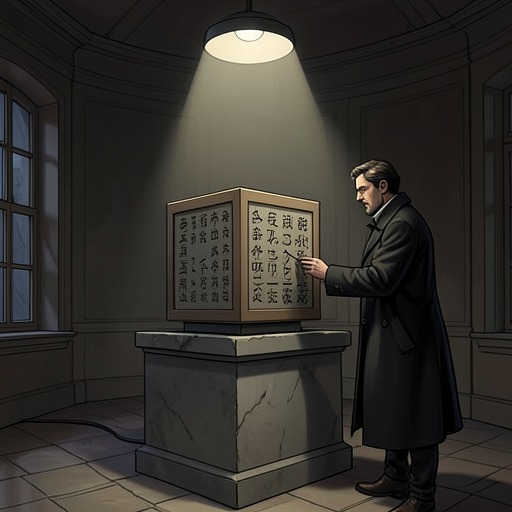
Gray Stone Box
The Lost SymbolThe Gray Stone Box is a small, puzzle-like container whose importance lies both in what it protects and in what it conceals. It holds the golden capstone separated from the Masonic Pyramid, while its unobvious opening, maker’s mark, and nearly invisible interior symbol provide successive prompts for interpreting the object and the larger cipher. Its solid-looking surface repeatedly invites the characters to look, and then to look differently.
Appearance and Opening
For much of the night, Robert Langdon carries Peter Solomon’s sealed package in his daybag, wary that Inoue Sato might discover it. The box inside is not revealed until Katherine Solomon removes the faded brown paper. Gray and polished like a granite cube, it has no visible hinges, latch, or ordinary means of entry. An X-ray has shown that it is hollow and contains a capstone, but its exterior gives no obvious sign of how to reach it.
Katherine finds a narrow, concealed slit along one of the top edges. She sets the box on a desk and carefully pries the lid open; it rises smoothly, like the top of a jewelry box. Inside lies the golden capstone, which reflects the desk lamp so brightly that its radiance initially seems almost self-generated. Though it has been sealed in the dark stone container for more than a century, the gold remains untarnished. The contrast between the heavy, closed cube and the exposed gold makes the box both a barrier and a means of preservation.
The capstone bears a brief inscription. Langdon has explained that the separated stone is meant to serve as the key, or legend, for reading the Masonic Pyramid. When Katherine reads the inscription, however, she finds it startlingly unhelpful. She examines every side of the capstone and returns it to the box, while the two searchers remain without the clear answer they had expected. The container safeguards a crucial component, but possession of that component does not immediately make its meaning transparent.
The Mark Dated 1514
A further clue appears not on the capstone but on the box itself. Near the bottom corner of one side, Katherine notices a tiny carving that resembles the date 1514 A.D. She brings it to Langdon’s attention, suggesting that the box may imitate a Masonic cornerstone and that its date might point toward a building erected in that year. Her observation changes the direction of the investigation: a detail that seemed decorative or historical may be part of the cipher.
Langdon recognizes that the inscription should not be read as a straightforward date. The letters A.D., he realizes, function as a German symbature—a personal sign or monogram used in place of a name—not as the Latin Anno Domini. He tells Katherine that A.D. refers to a person, and the discovery gives him the missing link he needs to proceed. The box’s marking thus does not simply date its manufacture; it directs attention from chronology to authorship and encoded reference.
The subsequent discussion of Albrecht Dürer’s engraving Melencolia I makes the connection more concrete. Its celebrated four-by-four magic square has rows, columns, and diagonals totaling thirty-four, as well as additional groups of four that share the same sum. Dürer placed 15 and 14 together in the bottom row to indicate the year of the work. Langdon and Katherine use the familiar arrangement as a comparison for the letter grid on the pyramid. The box’s 1514 mark helps move their reading toward this particular historical and mathematical frame, though the box itself does not contain the completed solution.
A Clue Hidden to Touch
After the golden capstone has been removed, the box still has something to disclose. Colin Galloway guides Langdon’s index finger around its interior, explaining that sight alone has missed a remaining lesson. Langdon feels a tiny raised circle, a minute dot at the center of the base. It is almost invisible to the eye, and the smooth interior initially seems empty; the clue becomes legible only through touch.
Galloway instructs Langdon to press down on the raised point and hold his finger there. When Langdon lifts it, the box appears unchanged, but an indentation remains on his skin: a small circle with a dot in the middle. Katherine identifies the mark as the ancient symbol for gold. Galloway calls the exercise an alchemical transformation, describing it as the creation of gold from a worthless substance. No material gold has been produced; the transformation is an impression on Langdon’s fingertip, and the box’s lesson is symbolic rather than literal.
Langdon recognizes the mark as a circumpunct, a sign with many meanings across different traditions. He lists associations including the Egyptian sun god Ra, the astronomical symbol for the sun, spiritual illumination, and the Eye of God. Galloway has deliberately led him to demonstrate this knowledge. The episode shifts the box from a container to an instrument of interpretation: the small mark does not dictate a single meaning, but tests whether Langdon can recognize the symbolic field surrounding it.
Role in the Pyramid’s Cipher
The box connects several stages of the search without itself resolving every question. Its capstone is presented by Warren Bellamy as the reading key for the Masonic Pyramid, whose cipher Langdon begins to decode using a simple grid of letter enclosures. The box then contributes its own dated mark, which redirects the pair toward Dürer and the four-by-four magic square. Its tactile circumpunct adds another emblematic lesson, reinforcing the story’s repeated insistence that signs can change with the method used to inspect them.
The final puzzle extends beyond the box. Mal’akh later understands that the pyramid’s base requires an eight-by-eight magic square, the order-eight square associated with Benjamin Franklin, to rearrange its sixty-four symbols. That operation depends on the pyramid’s base and its sequence, not on the Gray Stone Box as a separate cipher device. The distinction matters: the box preserves and helps interpret the capstone, while the capstone and pyramid together lead toward further codes. The box’s changing roles—as sealed container, clue-bearing surface, and tactile teaching device—make it a compact model of the larger mystery, in which apparent emptiness and apparent simplicity conceal information that only a changed perspective can disclose.